
By Jack Glennon
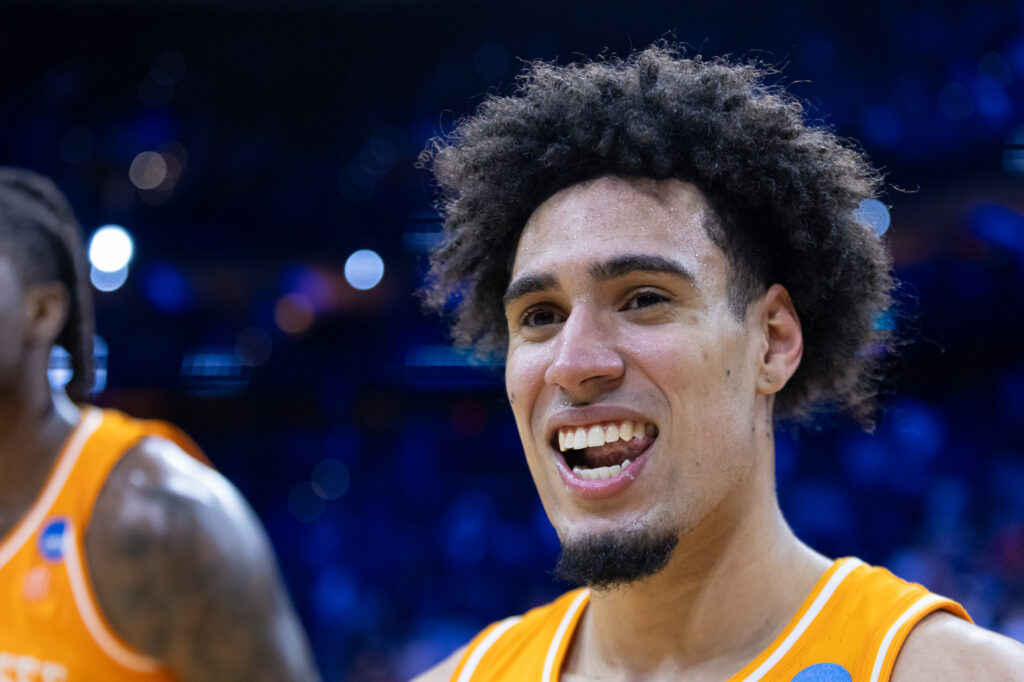
As shocking as it may sound, the No. 6 Tennessee Volunteers are advancing to their fourth consecutive Sweet 16 after escaping the No. 3 Virginia Cavaliers, 79-72.
While the Volunteers outplayed the Cavaliers in almost every aspect of the game, crediting Tennessee with a fantastic performance would be a stretch.
Virginia Head Coach Ryan Odom was the unfortunate victim of a Cavaliers mutiny, evidenced by his team’s horrendous shot selection.
Of 32 first-half field goal attempts, 16 came from beyond the arc. Such despicable shot selection is a great recipe for unmitigated disaster.
Odom, however, failed to adjust.
The Cavaliers would go on to attempt another 19 threes in the second half. They finished Sunday’s loss with an unimpressive 12 of 35 (34.3%) from beyond the arc.
“It’s hard to win,” Odom said. “Every team has one life, and unfortunately ours ended [sooner] than we wanted it to.”
For the past decade, “live by the three, die by the three” has become an increasingly common slogan for perimeter-centric offenses.
With the notable exception of the Golden State Warriors, who in the mid-to-late 2010s transformed basketball into a perimeter-centric game, teams reliant on three-point shooting have met a tragic postseason fate.
A season ago, the Illinois Fighting Illini attempted over 30 three-point field goals per game and, unsurprisingly, lost to the Kentucky Wildcats in the second round of the NCAA tournament.
In the disastrous loss, the Illini attempted 32 three-point shots, sinking a measly nine.
Perhaps the most infamous of such meltdowns came in Game 7 of the 2018 Western Conference Finals, when the Houston Rockets made just 7 of 44 three-point attempts, including an NBA record 27 straight misses.
Houston lost by just nine points. They won the rebounding and turnover battles, yet their abysmal shot selection cost them a trip to the NBA Finals.
Had the Rockets attacked the interior more frequently (they finished the game 29-46 from inside the arc), they would have undoubtedly sent the 58-24 Golden State Warriors on the next flight back to Oakland.
Similarly, if Tennessee’s first two tournament opponents had attacked the paint, the Volunteers would likely be watching the Sweet 16 from Knoxville.
Instead, it was Tennessee’s shot selection that bought them a trip to Chicago, Illinois, where they will face the No. 2 Iowa State Cyclones in the Sweet 16.
The Volunteers went 26 of 55 from the field, while attempting just 19 shots from beyond the arc.
Most importantly, they scored 28 points in the paint.
“Deep down inside, I wish there was no three-point line,” Tennessee Head Coach Rick Barnes said. “I believe [in] playing inside-out. I still believe in hard screening, [in] hard cutting.”
While it is safe to assume Barnes, who turns 72 in July, is an old-fashioned coach, his philosophy still rings true despite the sport’s rapid evolution.
Recent NCAA champions have consistently boasted a dominant frontcourt. The Florida Gators’ 2025 national championship team featured the likes of Alex Condon and Reuben Chinyelu.
Even in the NBA, the 2024 World Champion Denver Nuggets were led by Nikola Jokic, and the 2021 Milwaukee Bucks were dragged to a championship by Giannis Antetokounmpo.
Both players are at least 6 feet 11 inches tall.
Tennessee’s size advantage also played a significant role in the Cavaliers’ agonizing defeat.
The Volunteers outrebounded Virginia 39-35, and Odom believes this made the difference.
“They are so good at offensive rebounding,” Odom said. “We had too many breakdowns [defensively].”
Unfortunately for Virginia, Odom is far from wrong, as the Cavaliers’ backcourt defense deteriorated as the game progressed.
Sophomore guard Bishop Boswell played a large role in the Volunteers’ offensive success, scoring 13 points while dishing out nine assists. He also notched a career-high four three-pointers.
Already serving as the team’s top perimeter defender, Boswell’s offensive contributions open up the floor for Tennessee, making the Volunteer offense unpredictable.
Further, it makes life easier for Boswell’s backcourt counterpart, Ja’Kobi Gillespie, who has shouldered a majority of the offensive load for Tennessee since Nate Ament’s Feb. 28 ankle injury.
“That makes us a [different] team,” Gillespie said. “If [Bishop] plays like that…we are going to be really hard to beat.”
Boswell’s contributions also extend well beyond the box score.
Tennessee’s Elite Eight losses in each of the past two seasons can be attributed to the complete absence of a supporting offensive cast.
In 2023-2024, against Purdue, forward Dalton Knecht scored 37 of the team’s 66 points, but the Volunteers still fell six points shy of their first Final Four appearance.
The following season, Chaz Lanier scored 17 of the team’s 50 points in a season-ending blowout loss to Houston.
If Boswell can take even a small amount of weight off the shoulders of Ament and Gillespie, Tennessee’s offense would improve drastically.
Before that, however, Barnes will have to find a way to break through a stout Cyclones defense, which allows just 65.4 points per game, the 13th lowest in the nation.
Tennessee’s date with Iowa State will take place on Friday, March 27 (time TBD) in Chicago, Illinois.