
By Jack Glennon
KNOXVILLE, Tenn. – Oregon and Washington. California and Texas. Kentucky and Tennessee. Though parts of the same nation, some states hold bitter rivalries that date back hundreds of years.
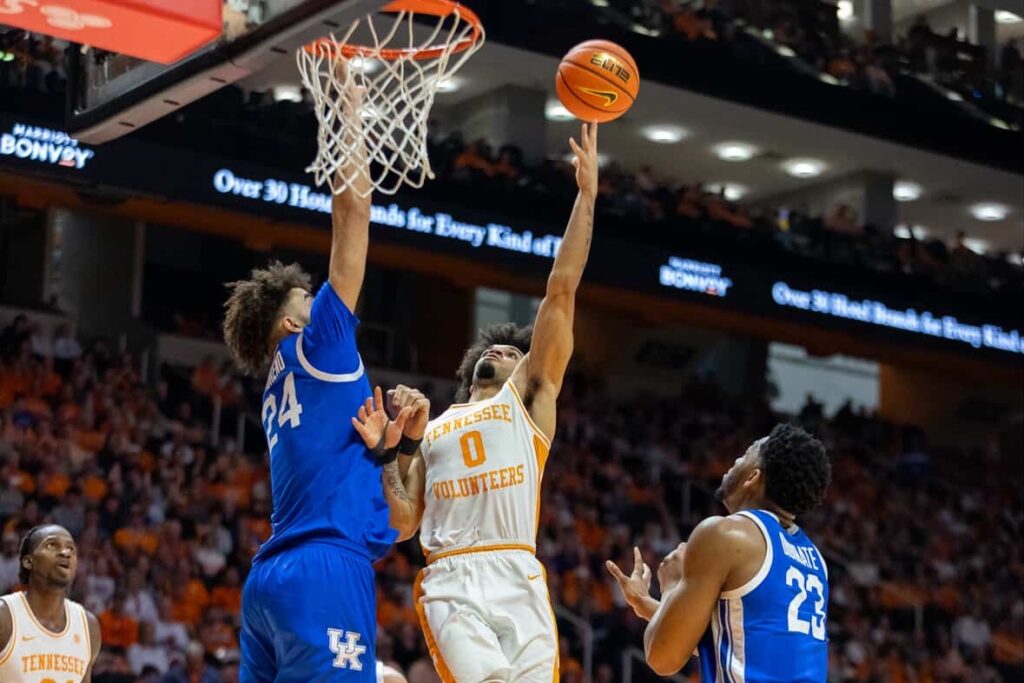
On Saturday, the Kentucky Wildcats and Tennessee Volunteers added an instant classic to an already historic rivalry, as the Wildcats narrowly escaped the Volunteers 80-78.
It is no secret by now that Tennessee has started the season lethargically, and a hard-earned win over Mark Pope’s Wildcats would have been exactly what the team needed to start moving in the right direction.
If Tennessee wants to win close games, however, rebounding is imperative.
In last week’s loss to Florida, Tennessee lost the rebound battle 37-29. This ultimately helped the Gators dismantle the Volunteers 91-67, despite shooting just 9-30 from beyond the arc.
In conference wins, though, Tennessee is outrebounding their opponents 90-54.
While Tennessee clearly misses the physical rebounding presence of sophomore forward Cade Phillips, forwards Jaylen Carey and DeWayne Brown II have kept the Volunteers afloat on the glass, averaging a combined 10 rebounds per game.
Though Tennessee was able to out-rebound Kentucky 36-29, the Wildcats were able to score 19 second-chance points, to the Volunteers six.
“I thought we got downhill [well]…” Kentucky Head Coach Mark Pope said. “[Offensive rotations] gave us more of an opportunity to get to the offensive glass… clearly it was really important for us.”
Kentucky also pulled down 13 offensive rebounds in the second half, suggesting an inexcusable lack of grit from the Volunteer frontcourt.
“When you get outrebounded, it is [a] lack of effort,” Rick Barnes said postgame.
The real test for the Volunteers will come in March, as the Volunteers have not won the rebounding battle in an NCAA Tournament loss since 2014.
Year after year, the deepest, most well-coached teams find consistent success in the NCAA Tournament.
Fortunately for Tennessee, they have a future Hall of Fame Head Coach at the helm in Rick Barnes.
Tennessee’s biggest weakness, though, is their lack of production from their reserves. And it has been for years.
In 2024, Dalton Knecht willed an otherwise unimpressive Volunteer team to the Elite Eight, but Tennessee’s lack of diversified production ultimately cost them their season.
A year later, Chaz Lanier and Zakai Ziegler could not carry Tennessee past Kelvin Sampson’s Houston Cougars in a similar Elite Eight loss.
Today, the Volunteer bench was outscored 36-22, marking the fourth time in five conference games in which Tennessee’s second unit has been unable to keep up with their opponents.
While the Volunteers do have a handful of reliable options on their bench (JP Estrella, Amaree Abram, and DeWayne Brown II), the second unit undeniably lacks a consistent scoring threat.
“We need JP [Estrella] to be the player we know he can be,” Barnes said after the game. “You [have] to do your job.”
Though Tennessee shot over 42% from beyond the arc, they missed nine free throws, an easily avoidable mistake that potentially cost Tennessee the game.
“Free throws are mostly mental,” forward Nate Ament said. “[It’s] just going up there with confidence.”
Apart from the lack of depth, one could argue that Tennessee’s shortcomings are all easily fixed.
Make of that what you will, but it might be the only hope that Tennessee has in a season that already looks lost.