
An examination of the Tennessee football program over the past decade
By Abraham Bates
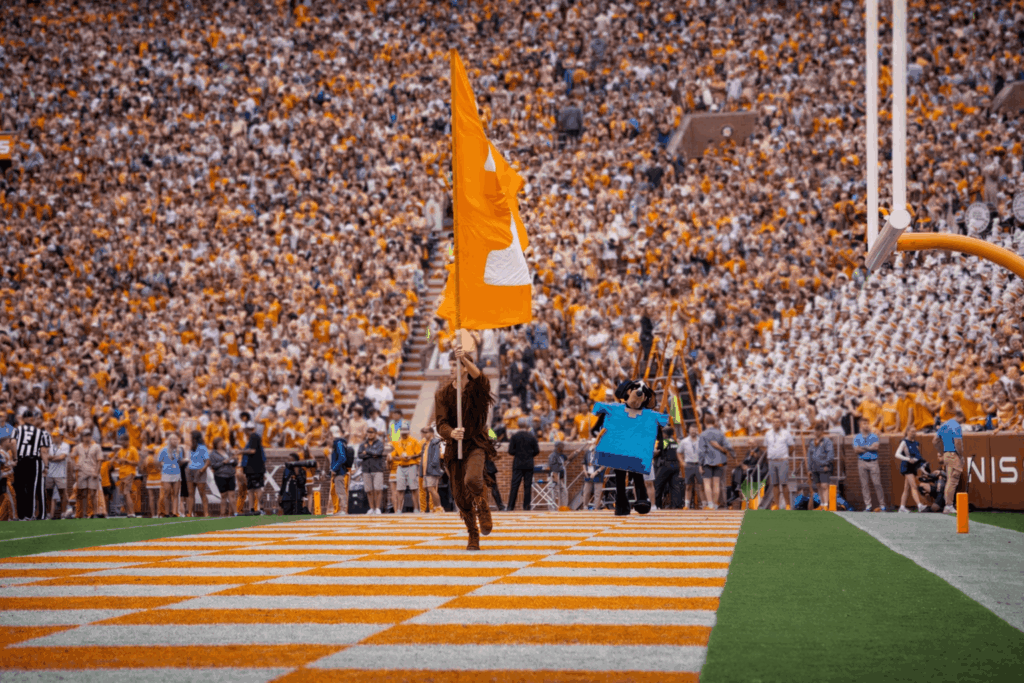
Over the past decade, Tennessee has cycled through coaching changes, NCAA turmoil, and brief flashes of success before stabilizing under Josh Heupel.
As the Volunteers close another season marked by both progress and inconsistency, the program’s direction has become a central question in the SEC.
This article examines how Tennessee arrived at its current position by tracking the pivotal moments, decisions, and performances that shaped the past 10 years, and evaluates where the Volunteers stand today as they try to regain a long-term footing in one of college football’s toughest conferences.
The Butch Jones Era (2013-2017)
After the dust had settled from the whirlwinds that were the tenures of the two previous Tennessee head coaches, Lane Kiffin (abruptly left for USC in January 2010) and Derek Dooley (hired in 2010 but fired in 2012), the Vols made Butch Jones the 25th head coach of the Tennessee Volunteers in December 2012. Jones, who came to Knoxville as the fourth coach in six seasons, was the head coach at Cincinnati, where he posted an overall record of 23-14 over three years with the Beacats.
The beginning of the Jones era on Rocky Top was certainly rocky to say the least. The drama around Kiffin’s departure and the three straight losing seasons under Dooley had left the program in a state of utter disarray. The Vols had become known for instability, coaching turnover, and unmet expectations during the late 2000s and early 2010s, but Jones hoped to revive the once-great and respected SEC program.
His first season in 2013 was nothing to write home about. The Vols finished 5-7 overall and did not meet bowl eligibility. Jones and the Vols returned in 2014, still flawed, but improved. They flashed young talent on both sides of the ball, with sophomore quarterback Joshua Dobbs playing in six games and making his case as the quarterback of the future, while players like Jalen Reeves-Maybin, Evan Berry, and Justin Coleman stood out on defense and special teams. Tennessee finished with a 7-6 record in 2014 and beat Iowa 45-28 in the TaxSlayer Bowl.
With momentum and elevated spirits going into 2015, the preseason AP poll ranked Tennessee at #25 in the nation. Jones named the now-junior Dobbs the starter, along with the likes of running backs Jalen Hurd and Alvin Kamara, along with young wide receivers Jauan Jennings and Josh Malone, all making an impact on the Vols’ offense. Tennessee would finish 8-4 in the regular season and then stomp Northwestern in the Outback Bowl, 45-6.
With the previously mentioned names all returning for the 2016 season, hopes were as high as they had been since the Fulmer era in Knoxville. The Vols would again be ranked in the preseason AP Top 25, debuting at No. 9. Jones and the Vols started hot, winning 5 straight games leading into a matchup between No. 9 Tennessee and No. 8 Texas A&M in week six of 2016. Final score from that game: Texas A&M 45 – Tennessee 38 (OT). That loss was the first of three straight in SEC play that dropped the Vols out of the rankings completely until they won their three games following that losing streak and came into a matchup versus Vanderbilt ranked 24th in the AP poll. Tennessee lost that matchup 45-34 in what felt like a gut punch to Vols fans everywhere, but they somewhat made up for it by beating Nebraska 38-24 in the Music City Bowl.
Back-to-back 9-4 seasons with three straight bowl wins had spirits as high as ever at UT, but expectations were equally as high. The Vols lost a great amount of talent on both sides of the ball. Joshua Dobbs, Alvin Kamara, Derek Barnett, Jaylin Reeves-Maybin, Josh Malone, and Cameron Sutton were all drafted to the NFL, along with other experienced talent either graduating or transferring, like previously-mentioned running back Jalen Hurd leaving to Baylor in the offseason.
Jones’ last year at Tennessee was horrible. The Vols went 4-8, with their only wins coming against Georgia Tech, Indiana State, UMass, and Southern Miss. In other words, they went 0-8 in SEC play and were beaten by at least two scores in five of those losses.
Jones was fired in November of 2017 after a 50-17 loss at Missouri, with Brady Hoke being named the interim and losing the last two games that year. Hoke would not return as head coach in 2018, and Tennessee was back to square one.
The Jeremy Pruitt Era (2018-2020)
Jeremy Pruitt arrived at Tennessee in December 2017 as a respected defensive coordinator with national championship credentials and a reputation for toughness. Tennessee turned to him after years of instability, hoping he could rebuild a program that had slipped far from its traditional standing. His early seasons showed glimpses of progress, but his tenure was ultimately defined by on-field inconsistency and an NCAA investigation that ended his time in Knoxville.
Pruitt inherited a depleted roster coming off one of the worst seasons in school history, yet he still managed to recruit and develop a core of talented players. His first two full recruiting classes produced several future NFL contributors, including offensive lineman Trey Smith, running back Ty Chandler, linebacker Henry To’o To’o, and defensive back Alontae Taylor. He also signed quarterback Harrison Bailey and brought in transfer quarterback Jarrett Guarantano, who served as the starter for much of his tenure. Several of these players became the foundation of Tennessee’s brief momentum, especially during the 2019 season.
That year marked the high point of the Pruitt era. After a disastrous 0–2 start that included a loss to Georgia State, Tennessee rallied to win six straight games, finishing 8–5 with a Gator Bowl victory over Indiana. The turnaround helped restore optimism and suggested that Pruitt’s process might be taking hold. The players publicly praised his approach, and Tennessee’s recruiting rankings climbed.
But the gains proved short-lived. The 2020 season unraveled quickly amid offensive struggles, quarterback instability, and mounting internal issues. Tennessee lost seven of its final eight games, and several key players, including To’o To’o and running back Eric Gray, later entered the transfer portal.
In January 2021, an internal UT investigation revealed recruiting violations that led to Pruitt’s firing for cause. The findings triggered a cascade of staff firings and roster departures, forcing Tennessee to endure yet another reset. While Pruitt showed an ability to identify and develop talent, his tenure ended with the program engulfed in turmoil because of how he acquired that talent.
Pruitt’s time at Tennessee remains a cautionary chapter: a tenure that produced moments of hope but ultimately left the Vols facing sanctions, instability, and the need to start from square one once again.
The Josh Heupel Era (2021-Present)
Tennessee suddenly found itself needing a new athletic director and head football coach in late January 2021. Confidence was low on Rocky Top, and expectations were even lower. But, on the 21st of that month, the school hired Danny White as its new athletic director, who immediately got to work on finding the school’s next head football coach. Just under a week later, on the 27th, UT announced that UCF head coach Josh Heupel would become the 27th head coach of the Tennessee Volunteers.
Heupel, a former national title-winning quarterback and Heisman trophy candidate at Oklahoma, was known for his fast-paced offense at UCF. He brought that same offensive philosophy with him to Tennessee, and the Vols hit the ground running.
Tennessee finished the 2021 regular season 7-5, showing great improvement throughout the course of the year. After naming Virginia Tech transfer Hendon Hooker the starter over Joe Milton III in week two, the offense averaged 38 points per game over the rest of the season. Hooker developed a great connection with his talented weapons at wide receiver, including future NFL talent such as Cedric Tillman, Jaylin Hyatt, and Velus Jones Jr. The fast-paced, high-scoring offense gave the Vols an identity they had lacked for several years. They finished the season with a close loss to Purdue in the Music City Bowl, 48-45 in overtime.
(Writer’s note: I was actually at the Music City Bowl versus Purdue. We should’ve won. Jaylen Wright was in, and I’ll defend that until I die.)
If 2021 showed promise for Tennessee, 2022 put it on full display. The Vols opened the season with eight straight wins, including ranked wins versus Pitt, Florida, LSU, Alabama, and Kentucky. The crown jewel of that season came at home when No. 6 Tennessee played No. 3 Alabama. As anybody who lives in Tennessee or pays attention to college football knows, Tennessee won that game 52-49 on a last-second field goal by Chase McGrath. That win marked the first against the Crimson Tide since 2006, and Tennessee was ranked #1 in the initial College Football Playoff poll of 2022.
The win against Alabama brought hope that some Vols’ fans had never felt before.
“I wasn’t born the last time [Tennessee] beat Alabama,” said sophomore UT student Asa Bates. “That was the best I had felt about the Vols in my entire life.”
Unfortunately, Tennessee had to go play Georgia in Athens two weeks later.
No. 1 Tennessee lost 27-13 to No. 3 Georgia on the road. It was the first time that the Vols had been outclassed in almost every facet of the game in that season. Two weeks later, #5 Tennessee would get blown out by South Carolina on the road, 63-38, and 2022 SEC Offensive Player of the Year Hendon Hooker would tear his ACL in that game. That loss knocked the Vols out of the playoffs, but Joe Milton would take the reins at quarterback and give the Vols hope for next year as he showed out against Vanderbilt in the last game of the regular season and in the Orange Bowl against Clemson, throwing for over 250 yards and 3 touchdowns in a 31-14 win against the Tigers.
Tennessee entered the 2023 season carrying momentum from its breakthrough year, but the Vols faced the challenge of replacing several key stars, including Hendon Hooker, Jalin Hyatt, and Cedric Tillman. Expectations remained high, but the roster became a blend of experienced holdovers and emerging contributors learning on the fly. Joe Milton started the year at quarterback and delivered a steady, if not spectacular, performance while the offense found new playmakers in running back Jaylen Wright and wide receivers Bru McCoy and Ramel Keyton. On the defensive side, edge rusher James Pearce Jr. developed into a force and gave the Vols a dependable pass rush.
Tennessee finished the season with a solid record of 8-4 and earned another bowl win when they smashed Iowa 35-0 in the Citrus Bowl, a game where 5-star true freshman Nico Iamaleava showcased his dual-threat ability in orange and white. The Vols continued to show high-tempo offense and flashes of explosive scoring, but inconsistency kept them from breaking into the SEC’s top tier. Still, Heupel’s third season underscored that Tennessee had achieved something it had long lacked: sustained competitiveness.
2024 was still a successful year in the eyes of most Vols’ fans. The team finished 10-2 in the regular season, including a win against Alabama at home. Redshirt freshman and first-year starting quarterback Nico Iamaleava continued to showcase his dual-threat talent in a Heupel offense that seemed to lean more on the ground game to better suit the young quarterback. Running back Dylan Sampson was named the SEC Offensive Player of the Year after posting 1,491 rushing yards and 22 touchdowns, both of which are single-season school records. Tennessee even made the inaugural 12-team College Football Playoffs, where they lost badly to the eventual national champion, Ohio State.
However, there were concerns about how the season turned out. Specifically with Iamaleava, who had reportedly signed a hefty Name, Image, and Likeness (NIL) deal with the school for his tenure on Rocky Top. Drama surrounding that and concerns about Iamaleava’s playstyle led to his transferring to UCLA late in the 2025 offseason, in April.
This move left Tennessee scrambling for an answer at quarterback. The candidates left on the roster included redshirt freshman Jake Merklinger and incoming 5-star true freshman George MacIntyre. The Vols would find their answer in, of all places, UCLA. Former Appalachian State quarterback Joey Aguilar had transferred to UCLA earlier in the offseason, but flipped his commitment to Tennessee after UCLA acquired Iamaleava in what seemed like a de facto college football trade, of sorts.
Aguilar would win the starting quarterback job over the summer and quickly get up to speed on the Huepel system. Before Tennessee, Aguilar was known as a gunslinger-type quarterback who was known for making big plays, but also being turnover-prone. Heupel, who had sent his two previous transfer quarterbacks, Hooker and Milton, to the NFL, hoped to refine Aguilar’s talent and make the best of an objectively messy offseason for the Vols.
Confidence and expectations were mixed going into 2025, with the main question being how Tennessee would look on offense with a new quarterback, and how the defense would look without James Pearce Jr., who the Atlanta Falcons selected in the first round of the 2025 NFL draft, and without preseason All-American cornerback Jermod McCoy, who tore his ACL during practice early in the offseason and would miss the entire 2025 campaign.
The season played out with Tennessee finishing 8-4 after starting 5-1. Aguilar and the offense performed above expectations, averaging 40.8 points per game and having the only SEC wide receiver trio to have three players with at least 700 yards through the air in Mike Matthews, Braylon Stayley, and Chris Brazzell II. Knoxville native and former walk-on DeSean Bishop added just under 1,000 yards on the ground and 14 touchdowns on the year.
The glaring issue for Tennessee was the defense. Losing McCoy in the offseason and fellow veteran starting cornerback Rickey Gibson III early in the season proved crucial as the Vols struggled to contain their SEC opponents. Despite an 8-4 record, Heupel and the Vols did not defeat a single ranked team in 2025 and lost their final regular-season home game in embarrassing fashion to in-state rival Vanderbilt.
Lingering Questions and Concerns
Who will start at quarterback for Tennessee next year? Currently, Aguilar has joined a lawsuit against the NCAA in hopes of gaining another year of eligibility to return to Tennessee.
However, Tennessee may choose to go in a different direction, with Merklinger and MacIntyre still on the roster, and top-ranked 5-star high school quarterback Faizon Brandon signing with the Vols for next year.
How will Tennessee fix the problems on defense? Defensive struggles have hindered the Vols from entering the upper echelon of the SEC for three out of the last four years. Tennessee addressed that issue this offseason by firing defensive coordinator Tim Banks and hiring former Ohio State and Penn State defensive coordinator Jim Knowles.
Despite all of this, the one overarching theme of the Heupel tenure is the program’s ability to bounce back from major setbacks that would have sunk the program in the tenures before his. Even after losing quarterbacks to injury or transfers, suffering heartbreaking losses to inferior opponents, or failing to meet expectations, Heupel and the Vols have rebuilt themselves into a respectable SEC program that still ranks among the best in recruiting every year.
One thing remains true: Heupel has brought sustained, consistent respectability to Rocky Top for the first time in a long time.
The State of Rocky Top
After a decade defined by turnover, missteps, and unmet expectations, Tennessee has rebuilt its footing and reestablished its identity under Josh Heupel. The program now operates with stability, a clear offensive philosophy, and a roster built through consistent recruiting and player development. Tennessee is no longer scrambling for relevance but competing with purpose, producing NFL-caliber talent and winning at a level that had become unfamiliar in the post-Fulmer years.
While the Vols have not yet reached the SEC championship stage, they have positioned themselves firmly in the conference’s upper tier and restored confidence inside and outside the program. The foundation is steadier than it has been in years, and Tennessee enters the next era not in search of direction, but with a realistic belief that its long climb back to national contention is finally within reach.