
By Jack Glennon
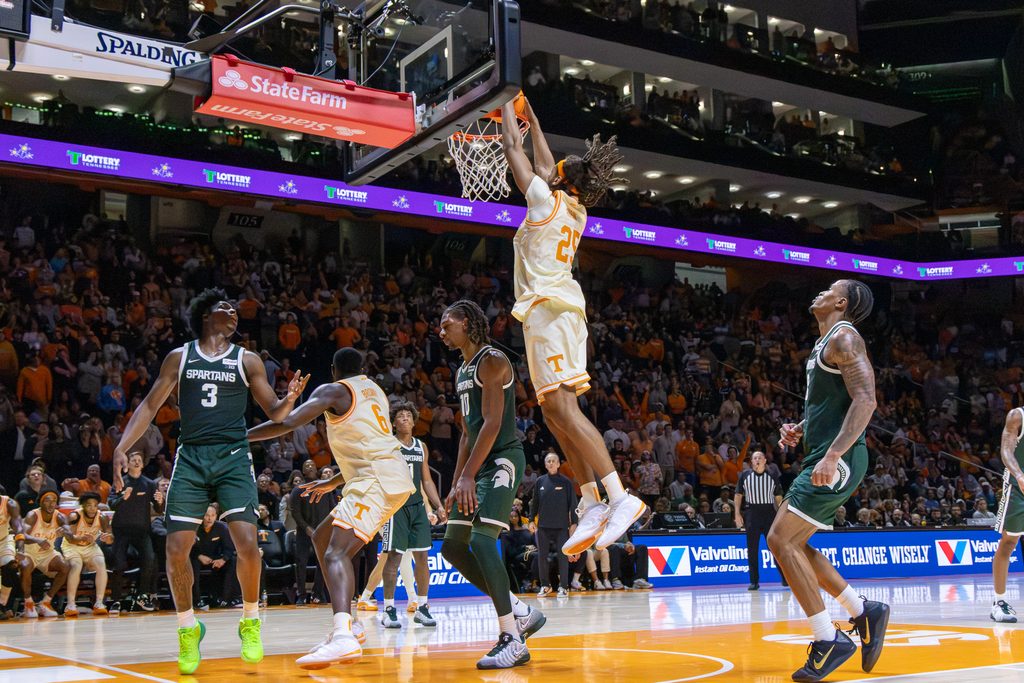
Four short days after defeating the unranked Tennessee State Tigers by a measly five points, No. 14 Tennessee knocked off the No. 2 Spartans in a shocking upset.
Despite the 61-46 win, the Tennessee Volunteers still have multiple issues to address before they can be seriously considered a Final Four favorite.
First, Tennessee must clean up its offensive turnovers if it wants to boast any semblance of a competent offense.
In the first half alone, Tennessee committed seven turnovers, yet miraculously entered the locker room clinging to a 27-25 lead.
They did so by holding the Spartans to an ice-cold 18% from the field.
“That’s a North American record for me,” Michigan State head coach Tom Izzo said. “In the history of Tom Izzo… that’s the lowest offensive output [in 32 years].”
Perhaps more concerning for the Spartans was that their two best players, Jeremy Fears Jr. and Coen Carr, combined to shoot a whopping 1-10 from the field.
Though Tennessee’s defense was undeniably suffocating, relying on that figure to become a trend for the Volunteers’ defense is simply unrealistic.
Against the Duke Blue Devils, who held the Volunteers to 33.9% from the field in an Oct. 20 exhibition match, the Spartans shot 44.6% from the field and 35% from beyond the arc.
Tennessee’s only defensive shortcoming on Tuesday evening was the same one that has plagued it since Rick Barnes took the helm in 2015: a complete inability to stay disciplined.
The Volunteers committed 20 personal fouls, affording the Spartans a nauseating 30 attempts from the free-throw line.
Come SEC play, allowing teams to shoot 30 free throws a game would almost automatically correlate to a loss.
The positive for Tennessee was its uncharacteristic continuity on offense, something fans have been waiting for since the Volunteers welcomed nine transfers following the 2025-26 season.
Given that the top eight transfers Tennessee acquired averaged 116.2 points per game last season, questions were rightfully raised about who would emerge as the team’s go-to scorer.
Surprisingly, Tennessee’s offense has been nothing short of anemic at the start of the season.
So how does Tennessee transform into the dynamic offense everyone expected them to be?
Well, the best part of a Rick Barnes-led team is that they do not need to be dynamic. They just need to work together.
And though the Volunteers managed to score just 61 points Tuesday evening, their offense looked far more competent than it did in non-conference play.
Despite making just 23 field goals, Tennessee collected 18 assists, good for a 78.3% clip.
For perspective, roughly 52% of all made field goals across the Division 1 level come off the heels of an assist.
That striking 26% difference indicates the Volunteers are finally figuring out how to work together.
And come March, teams like the Spartans will not be shooting 18% from the field.
Therefore, Tennessee will have no choice but to work together.
“As a team, we are executing way better [than before],” Rubin said. “We have players that have come from different schools [to now as] one team. We just need to come together as a team.”
There is little doubt that a Tennessee team with the likes of Terrence Hill Jr., Juke Harris, Dai Dai Ames, and countless others boasts the talent necessary to compete deep into the NCAA Tournament.
What remains to be seen, however, is which version of the Volunteers that Tennessee will get down the stretch.