
By Zion Murray
The Tennessee Volunteers return to Neyland Stadium on Saturday afternoon for one of their most important games of the season as they welcome the LSU Tigers to Knoxville for a late-season SEC showdown.
The No. 9 Volunteers enter the matchup riding the momentum of a two-game win streak after consecutive victories over Kentucky and Texas A&M. With two regular-season games remaining, Tennessee is right in the mix of the College Football Playoff conversation and has an opportunity to strengthen its resume with another conference victory.
Standing in the way is an LSU team that presents one of the more difficult defensive challenges Tennessee has faced all season. Despite entering the game at 6-4, the Tigers possess one of the nation’s top defensive units and an explosive passing attack capable of creating problems for opposing defenses.
The matchup also carries additional significance with LSU head coach Lane Kiffin returning to Knoxville, where he coached the Volunteers during the 2009 season. With playoff implications, an important SEC matchup and a familiar face on the opposing sideline, Saturday’s contest has plenty of storylines.
LSU Tigers (6-4)
LSU enters Knoxville looking to end a disappointing stretch after suffering consecutive losses against top-10 opponents Alabama and Texas.
Despite the recent setbacks, Kiffin’s first season in Baton Rouge has produced an offense capable of competing with some of the best teams in the country. LSU is averaging 35.5 points and around 490 yards of total offense per game, ranking among the nation’s most productive offensive teams.
The Tigers’ offense is built around quarterback Sam Leavitt, who has had an up-and-down season thus far. Leavitt has completed 242 of 340 passes for 2,797 yards, 19 touchdowns and 12 interceptions. He has also contributed 337 rushing yards and eight touchdowns on the ground, giving LSU another dimension when opposing defenses struggle to contain him in the pocket.
His ability to extend plays and create opportunities with his legs makes him a difficult quarterback to defend. Tennessee’s defensive front will need to maintain its assignments rather than immediately abandoning its pass rush when Leavitt escapes the pocket. Allowing him to scramble outside the pocket could be key in extending drives for the Tigers.
Leavitt’s biggest weakness has been turnovers. His 12 interceptions are a concerning number for a quarterback leading an offense with this much talent and production. He threw three interceptions against Texas, giving Tennessee’s secondary an opportunity to take advantage of his mistakes. The Volunteers have recorded 11 interceptions this season and will look to continue creating opportunities for takeaways.
LSU’s passing attack is dangerous as it leads the SEC with 316.8 passing yards per game. Wide receiver Jackson Harris leads the way with 55 receptions for 864 yards and nine touchdowns. Winston Watkins Jr. has contributed 517 receiving yards and two touchdowns, while Eugene Wilson III has added 441 yards and a touchdown. The 6-foot-7 tight end, Trey’Dez Green, has also become a focal point of the passing game with 406 receiving yards and two touchdowns.
The Tigers will need to establish some balance quickly on Saturday in terms of the run game. Running back Dilin Jones leads the Tigers with 838 rushing yards and eight touchdowns on 185 carries. If LSU can establish Jones and the run game early, it could force Tennessee to bring additional defenders toward the line of scrimmage, creating more favorable opportunities for Leavitt and the receiving corps downfield.
Defensively, LSU presents a significant challenge for Tennessee. The Tigers are allowing approximately 262 yards per game, ranking among the top five defenses nationally. They have been particularly effective against the run, surrendering just 86.1 rushing yards per game.
Their ability to stop the run will be especially important against a Tennessee offense that relies heavily on establishing its ground game. LSU has the defensive personnel to close running lanes quickly and to force offenses into uncomfortable passing situations. The Tigers will look to take advantage of an offensive line that has been up and down as they lead the country in total sacks with 40.
Kiffin’s return to Knoxville adds another storyline to an already important matchup. Saturday will be another opportunity for him to face the program he once led, but his immediate focus will be finding a way to end LSU’s two-game losing streak.
#9 Tennessee Volunteers (8-2)
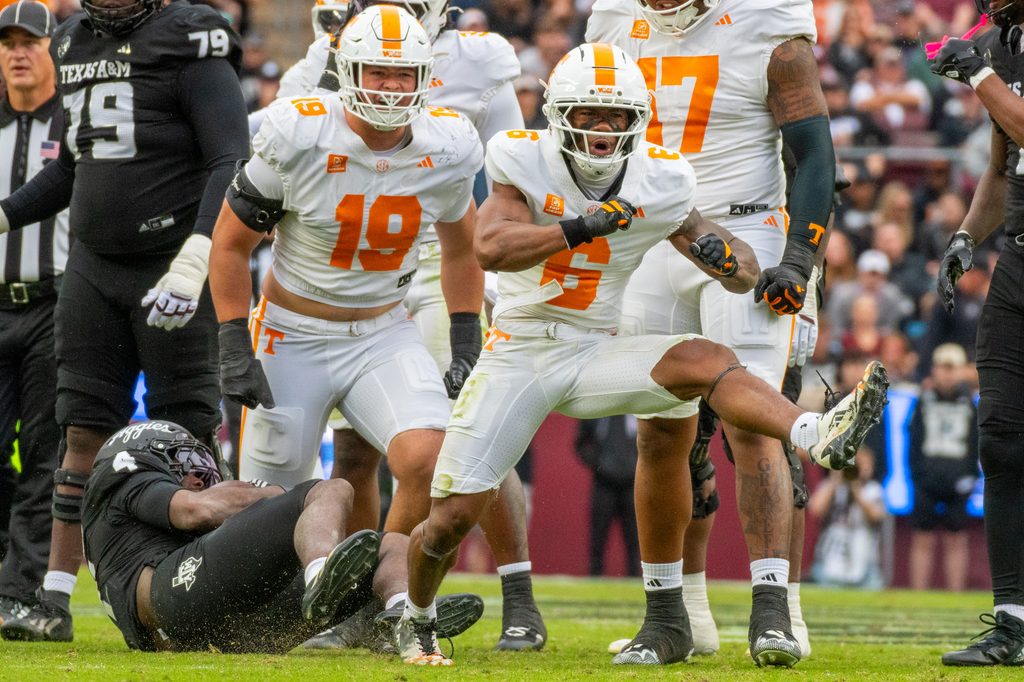
Tennessee enters Saturday following one of its most impressive defensive performances of the season. The Volunteers traveled to College Station last weekend and defeated Texas A&M 22-7, holding the Aggies to just 179 total yards of offense.
The defense has become the identity of this Tennessee team. Through 10 games, the Volunteers are allowing just 14.3 points and 284.7 yards per game. They have also surrendered only four passing touchdowns while recording 11 interceptions.
Tennessee has been particularly impressive after halftime, recording consecutive second-half shutouts against Kentucky and Texas A&M. The Volunteers have outscored their last two opponents 40-0 after halftime, demonstrating their ability to make adjustments and take control of games as they progress.
That defensive production will be critical against an LSU offense averaging nearly 317 passing yards per game. Tennessee’s secondary will have to limit explosive plays, communicate effectively against pre-snap motion and avoid allowing LSU’s receivers to find open space between the numbers.
While LSU leads the country in sacks with 40, Tennessee’s defense is right behind with 39. The Volunteers’ defensive front will have an important assignment containing Leavitt. Keeping him contained and forcing him to make difficult throws under pressure should be a major priority.
The Tennessee defense needs to take advantage of Leavitt’s turnover-prone tendencies on Saturday. The Tennessee secondary has been a strong unit in getting turnovers through the air and the Vols are banking on keeping Leavitt’s turnover pattern going. Getting pressure on Leavitt and speeding up his decision-making will be key for the Vols in getting the explosive Tigers’ offense off the field.
Tennessee’s biggest advantage on the offensive side of the ball remains its rushing attack. DeSean Bishop has established himself as one of the SEC’s premier running backs, recording 1,163 rushing yards and 13 touchdowns through 10 games. He is averaging more than 116 rushing yards per game and continues to be the centerpiece of Josh Heupel’s offensive system.
Running against LSU will be a challenge the Vols have not faced yet. The Tigers are exceptional when stopping the run, meaning Tennessee may need to find ways to create favorable matchups rather than repeatedly running directly into a crowded defensive front. Getting Bishop into space and forcing defenders to make open-field tackles could be more productive than relying exclusively on inside runs.
The Volunteers will also need contributions from their passing game. Quarterback George MacIntyre has completed 91 of 134 attempts for 962 yards, two touchdowns and three interceptions. He left the Texas A&M game with a knee injury, but Heupel expressed optimism that he would be available to start Saturday.
If MacIntyre cannot play or is limited, freshman Faizon Brandon provides another option. Brandon has thrown for 726 yards and nine touchdowns while recording just one interception. His mobility also gives Tennessee another element to incorporate into its offensive approach.
Whoever starts at quarterback for the Vols on Saturday will need to be protected from LSU’s disruptive defensive front. The offensive line has somewhat struggled this season against premier defensive lines and will need to play their best on Saturday as the Tigers lead the country in sacks. Keeping the quarterback on their feet and giving them time to go through their progressions will be key in the offense finding a rhythm.
One of the biggest challenges for Tennessee will be replacing wide receiver Mike Matthews, who suffered a season-ending injury against Texas A&M. Matthews had led the Volunteers with 608 receiving yards and four touchdowns. His absence puts additional responsibility on Braylon Staley, tight end DaSaahn Brame and the rest of the receiver corps to create opportunities through the air.
Against an LSU defense that has been so effective at stopping the run, Tennessee cannot afford to become one-dimensional. Establishing a passing threat will be important to preventing the Tigers from loading the box and dedicating additional defenders to stopping Bishop.
Lane Kiffin enters Saturday’s matchup with a 1-9 record on the road against AP Top 25 teams, giving him an opportunity to prove himself against one of the nation’s top programs. Although LSU’s playoff hopes are gone, the Tigers have plenty of motivation to play spoiler and potentially end Tennessee’s postseason aspirations.
However, the Volunteers will have the advantage of playing in front of their home crowd, where the atmosphere will be a major factor in a game with significant playoff implications. With two of the country’s most productive defenses facing off, Saturday’s matchup could ultimately become a defensive battle in which turnovers, field position and a handful of offensive opportunities determine the outcome.